TOEFL Take an Interview: 5 Answer Frameworks (2026)
Build clear TOEFL Take an Interview answers with five flexible frameworks for opinions, experiences, choices, problems, and follow-ups—without memorizing scripts.
By Clario Team · · 4 min read
Quick answer: For an opinion question, use Answer → Reason → Example → Close. For a personal experience, use Situation → Action → Result → Relevance. These are planning frameworks, not sentences to memorize.
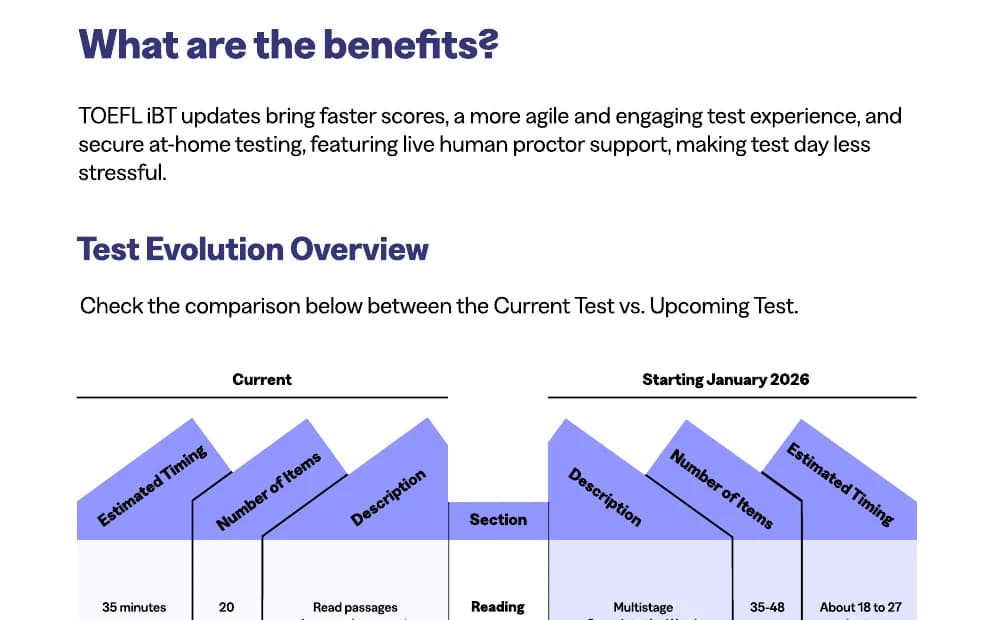
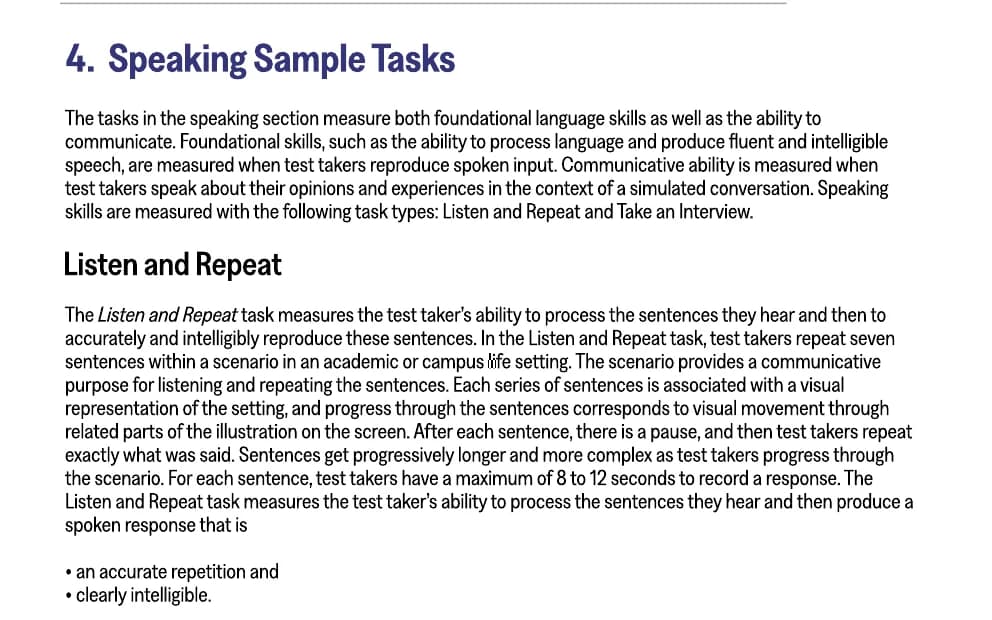
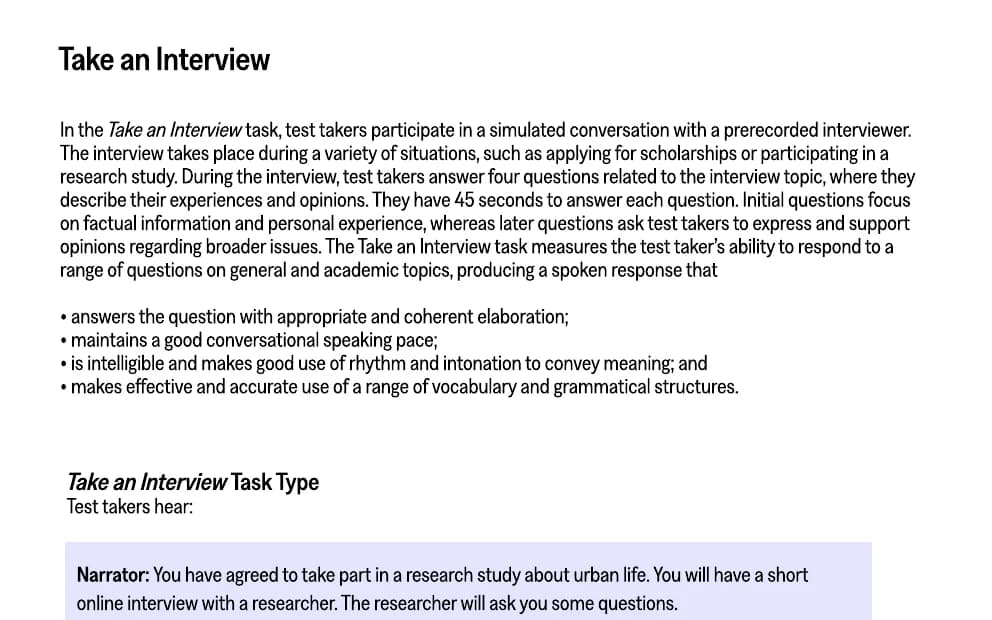
The updated TOEFL Speaking section includes Take an Interview, a simulated interview about academic or campus situations. ETS says the task measures your ability to communicate clearly, maintain a natural pace, and use appropriate vocabulary and grammar. Review the official task description before using any third-party study advice.
Template versus memorized script
A safe framework tells you what kind of idea comes next. A memorized script supplies generic sentences regardless of the question. ETS says a template may help as a general blueprint, but warns that using language from other sources or previously memorized passages can violate its policies. Read the official ETS policy explanation.
| Flexible framework | Risky script |
|---|---|
| “State my choice, then explain one reason.” | “There are numerous compelling reasons why…” for every prompt. |
| Your own experience and vocabulary. | A prewritten story adapted superficially. |
| Different length and language for each question. | The same opening, transitions, and closing every time. |
Framework 1: Answer → Reason → Example → Close
Best for: opinions, preferences, and agreement questions.
- Answer: make your position clear immediately.
- Reason: explain the strongest reason.
- Example: make the reason concrete with a real or plausible detail.
- Close: connect the example back to your answer.
Original practice prompt: Would you rather study in the library or at home?
Example shape: “I usually choose the library because I concentrate better in a place designed for study. At home I tend to interrupt my work to check messages or do small chores. Last semester, moving my evening review sessions to the library helped me finish earlier. So for focused work, the library is more effective for me.”
Framework 2: Situation → Action → Result → Relevance
Best for: questions about a past experience, challenge, or achievement.
- Situation: give only the context the listener needs.
- Action: say what you did.
- Result: explain what changed.
- Relevance: answer why the experience matters now.
Original practice prompt: Tell me about a time you had to learn something quickly.
Example shape: “In my first statistics course, I had to learn a new software tool before a group deadline. I divided the tutorial into small tasks and practiced with our actual data after each one. By the next meeting, I could prepare the graphs and show my teammates the same process. It taught me that immediate practice helps me learn technical skills faster.”
Framework 3: Choice → Two criteria → Decision
Best for: comparing two options.
Name the choice, compare the options using two relevant criteria, and finish with a decision. Useful criteria include time, cost, learning value, convenience, collaboration, or long-term effect.
Original practice prompt: Is it better to take a morning class or an evening class?
Avoid listing every possible advantage. Pick two criteria you can explain clearly and make sure both support your final choice.
Framework 4: Problem → Response → Benefit
Best for: advice, campus problems, and hypothetical situations.
- Restate the core problem in a few words.
- Give one practical response.
- Explain why that response would help.
Original practice prompt: What would you do if a class project partner repeatedly missed meetings?
A strong answer stays proportional: talk to the partner, clarify expectations, document the plan, and involve the instructor only if the issue continues. That sounds more thoughtful than jumping straight to an extreme solution.
Framework 5: Direct answer → New detail → Link back
Best for: follow-up questions in the same interview.
Do not repeat your previous answer. Respond directly, add one new detail, and show how it connects. If asked why an experience influenced you, name the specific effect instead of retelling the entire experience.
Natural transitions you can adapt
| Purpose | Simple language |
|---|---|
| Give a reason | “The main reason is…” / “That matters because…” |
| Add an example | “For example…” / “In my case…” |
| Contrast | “However…” / “The difference is…” |
| Show a result | “As a result…” / “That meant…” |
| Close | “So I would…” / “That is why…” |
These phrases are common organizing language, not a complete response. Use only the transition that the meaning needs.
A self-review checklist for every answer
- Did my first sentence answer the actual question?
- Did I develop one idea instead of listing several shallow ideas?
- Did my example support the reason?
- Was my pace natural enough to understand without strain?
- Did I use vocabulary and grammar I can control?
- Did I finish the thought instead of fading out?
Practice the structure without memorizing the wording
Choose one framework and answer three different prompts. Record each first attempt. Review only the structure, clarity, pace, vocabulary, and grammar; then retry once in your own words. The goal is to make organization automatic while keeping the language responsive to the question.
Use Clario's updated TOEFL practice for recorded attempts and focused retries, and pair it with the complete 2026 Speaking format guide. Clario's feedback is for practice and does not replace an official ETS score.
Frequently asked questions
Can I use a template in TOEFL Speaking?
A flexible structure can help organize an answer, but it should not supply memorized content. ETS warns that templates become risky when they go beyond a general blueprint, so answer each question in your own words.
What is a good structure for Take an Interview?
For an opinion, use answer, reason, example, and close. For an experience, use situation, action, result, and relevance. Choose the structure that matches the question rather than forcing one template onto every answer.
Should a TOEFL interview answer use advanced vocabulary?
Use precise words you control. Clear, appropriate vocabulary delivered naturally is more useful than inserting difficult words that make the response hesitant or inaccurate.
How should I practice these frameworks?
Answer a new prompt without a written script, review whether each part was present, then retry once with one improvement. Rotate frameworks so that the structure stays flexible.