TOEFL Listen and Repeat: Drills & 7-Day Plan (2026)
Improve TOEFL Listen and Repeat accuracy with a repeatable drill, original practice sentences, an error log, and a focused seven-day training plan.
By Clario Team · · 4 min read
Quick answer: Train Listen and Repeat with a five-step loop: listen once → repeat → compare → label one error → repeat again. Track wording accuracy and intelligibility separately so you know what to fix.
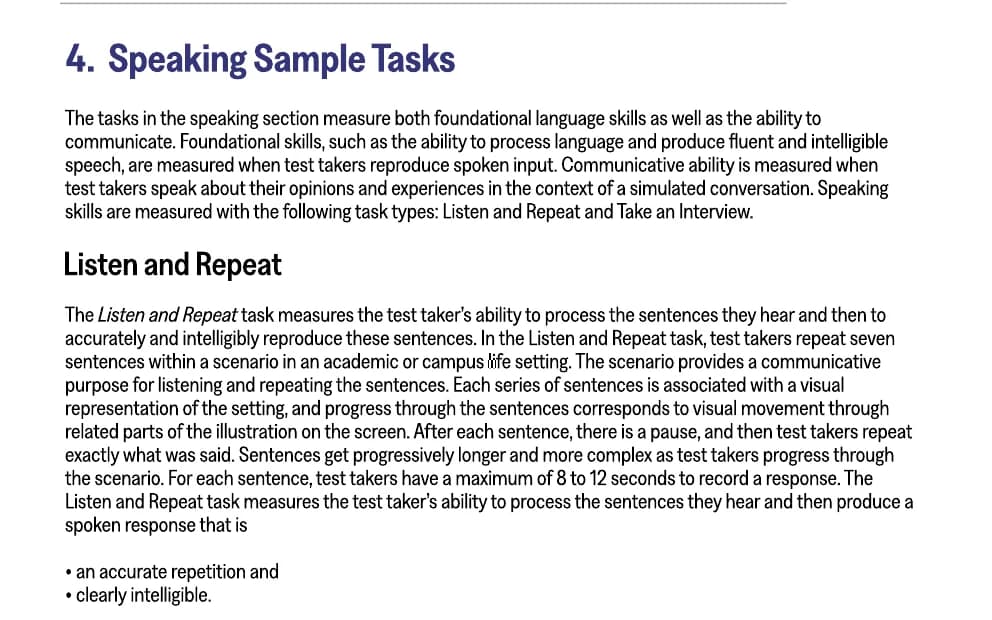
In the updated TOEFL iBT Speaking section, Listen and Repeat asks you to hear short sentences and repeat them as accurately as possible. ETS says it measures your ability to process spoken English and produce accurate, clearly intelligible speech. Confirm the task on the official TOEFL Speaking page.
The four parts of an accurate repetition
| Part | What to notice | Common error |
|---|---|---|
| Content words | Nouns, main verbs, adjectives, numbers, and names. | Replacing a specific word with a similar one. |
| Grammar words | Articles, prepositions, auxiliaries, and pronouns. | Dropping short unstressed words. |
| Endings | Plural -s, past -ed, possessives, and contractions. | Understanding the word but losing its ending. |
| Delivery | Stress, word groups, consonants, and a steady pace. | Rushing so much that correct words become unclear. |
The five-step Listen and Repeat drill
- Listen once without writing: hear the whole message and its rhythm.
- Repeat immediately: do not pause to compose a paraphrase.
- Compare with the source: check exact words, word order, endings, and intelligibility.
- Label one error: use a specific tag such as “missed article,” “changed verb,” or “unclear final consonant.”
- Repeat again: fix the tagged error while keeping natural rhythm.
Do not repeat the same sentence ten times mechanically. Two or three attentive attempts teach more than many repetitions without comparison.
Original practice sentences
These sentences were written by Clario for practice; they are not official ETS test items. Ask a partner or text-to-speech tool to play each sentence while the text is hidden.
Level 1: short and concrete
- The tutoring center closes at six today.
- Please bring your student card to the front desk.
- Our discussion group will meet after lunch.
- The professor posted the reading list online.
Level 2: one extra detail
- The science workshop has moved to the second floor of the library.
- Students can reserve a study room for up to two hours.
- Because the lecture starts early, the campus bus will arrive at seven.
- Your revised assignment must include the sources discussed in class.
Level 3: longer thought groups
- Although the first session is optional, new students are encouraged to attend.
- The research team will review the survey results before presenting its recommendations.
- If you need additional laboratory time, contact the instructor by Thursday afternoon.
- After the guest speaker finishes, there will be a short opportunity for questions.
How to chunk a longer sentence
Do not memorize isolated words. Hear meaningful groups. For example:
After the guest speaker finishes / there will be a short opportunity / for questions.
The slashes are practice marks, not pauses you must exaggerate. They show three units of meaning. First preserve the unit sequence; then work on the exact wording inside each unit.
Use a compact error log
| Sentence | First-attempt error | Correction target |
|---|---|---|
| “closes at six today” | Dropped “at” | Hear unstressed prepositions. |
| “students can reserve” | Said “could reserve” | Preserve the modal exactly. |
| “sources discussed” | Final sounds unclear | Finish both consonant clusters. |
Count patterns, not just total mistakes. If five errors are dropped endings, that is a much clearer training target than “memory.”
A seven-day Listen and Repeat plan
| Day | Practice | Goal |
|---|---|---|
| 1 | 10 short sentences | Establish exact-word baseline. |
| 2 | 8 sentences; focus on articles and prepositions | Preserve small grammar words. |
| 3 | 8 sentences; focus on -s and -ed | Make endings audible. |
| 4 | 6 longer sentences; mark thought groups after trying | Strengthen chunk memory. |
| 5 | Mixed accents from reliable English sources | Avoid depending on one voice. |
| 6 | Two mixed sets with no text visible | Practice first-attempt control. |
| 7 | Repeat Day 1 material | Measure whether recurring errors decreased. |
Three mistakes that slow improvement
- Paraphrasing: the task asks for repetition, so a correct summary is still the wrong training behavior.
- Practicing with visible text: reading can hide listening and short-term retention problems. Reveal text only when comparing.
- Chasing speed: fast speech is not useful if consonants, endings, or words disappear. Aim for an intelligible natural pace.
Combine repetition with interview practice
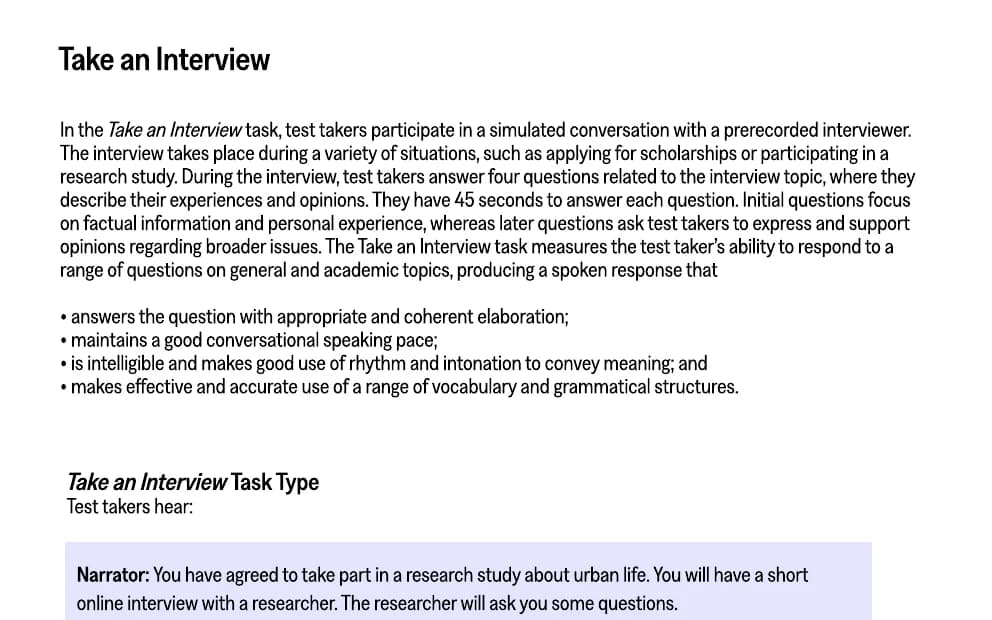
Listen and Repeat is only one of the two current Speaking task types. Use the Take an Interview frameworks on alternate days, and check the complete 2026 TOEFL Speaking guide for the official section overview.
For a guided correction loop, try Clario's TOEFL Speaking practice. It can help you review accuracy and intelligibility, but its estimates are for learning only and are not official ETS scores.
Frequently asked questions
What is Listen and Repeat in the 2026 TOEFL?
You hear a short sentence and repeat it as accurately as possible. ETS says the task measures spoken-language processing and speech that is accurate and clearly intelligible.
Should I repeat the meaning or the exact sentence?
Repeat the sentence as you heard it rather than paraphrasing the general meaning. Train exact wording, grammatical endings, word order, and intelligible delivery together.
How can I remember longer sentences?
Listen for meaningful chunks, keep a compact mental map of who did what and when, and reproduce the sentence in one connected delivery. Build from shorter sentences before increasing length.
Can I use these sentences as official TOEFL questions?
No. The sentences in this guide are original Clario practice material, not official ETS questions. Use official ETS materials to confirm the test experience.