2026 TOEFL Speaking: Format, Timing & Study Plan
The current TOEFL iBT Speaking section uses Listen and Repeat and Take an Interview. Learn what changed, what each task tests, and how to prepare.
By Clario Team · · 4 min read
Quick answer: The updated TOEFL iBT Speaking section has two task types: Listen and Repeat and Take an Interview. ETS lists 11 items and an approximate base time of 8 minutes. The format has applied since January 21, 2026.
If your study materials still teach the old four-task speaking section, use them only for general language practice. They do not reproduce the task sequence you will meet on the current test. Start with the official ETS Speaking description, then use this guide to turn the format into a practical routine.
2026 TOEFL Speaking format at a glance
| Official task type | What you do | Main practice target |
|---|---|---|
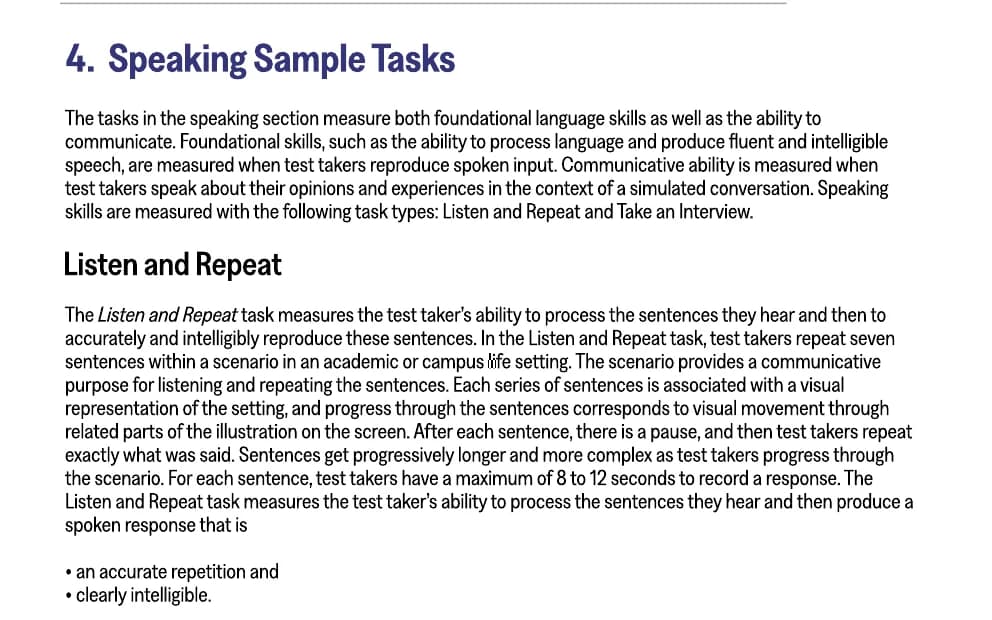
| Listen and Repeat | Hear a short sentence and repeat it as accurately as possible. | Processing, wording accuracy, pronunciation, and intelligibility. |
| Take an Interview | Answer questions in a simulated interview about academic or campus situations. | Clear ideas, natural pace, vocabulary, grammar, and relevant support. |
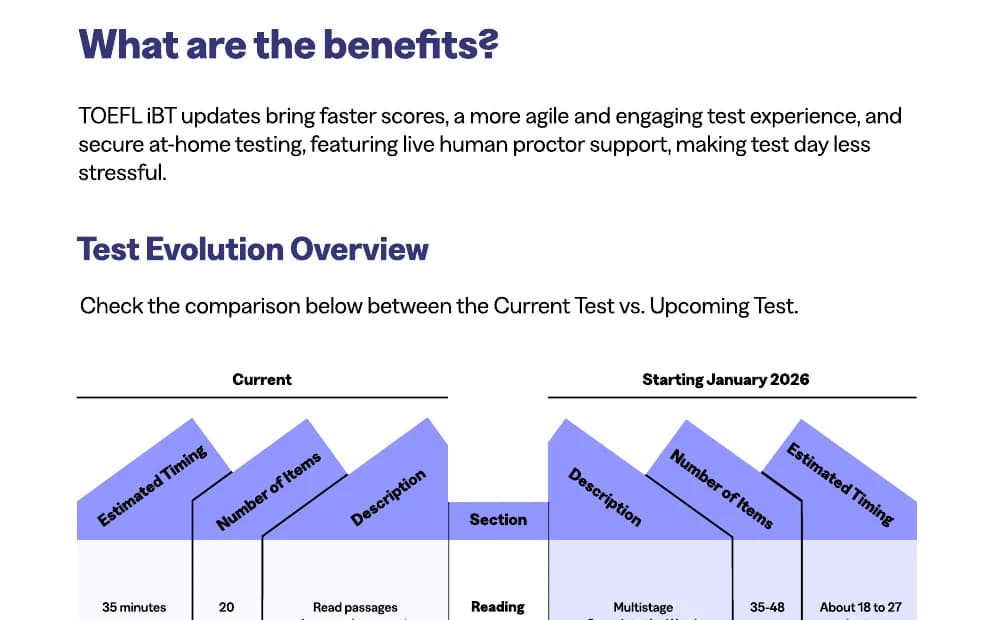
ETS says the complete Speaking section contains 11 items with an approximate base time of 8 minutes. Directions are outside that base time, and ETS notes that timing and item counts may vary as the test adapts. Treat 11 and 8 minutes as the official overview, not as a promise that every test experience is identical. See the official content and timing table.
What Listen and Repeat actually requires
This task is not a summary. You are trying to preserve the sentence you heard. Understanding the general idea is useful, but a response can still lose accuracy when it drops a small word, changes a verb ending, replaces a connector, or becomes hard to understand.
Practice in three layers:
- Capture the message: identify who did what, where, and when.
- Preserve the language: retain function words, endings, and the original word order.
- Deliver one intelligible sentence: use natural word groups instead of rushing individual words.
For drills and an original seven-day schedule, use the TOEFL Listen and Repeat practice guide.
What Take an Interview actually requires
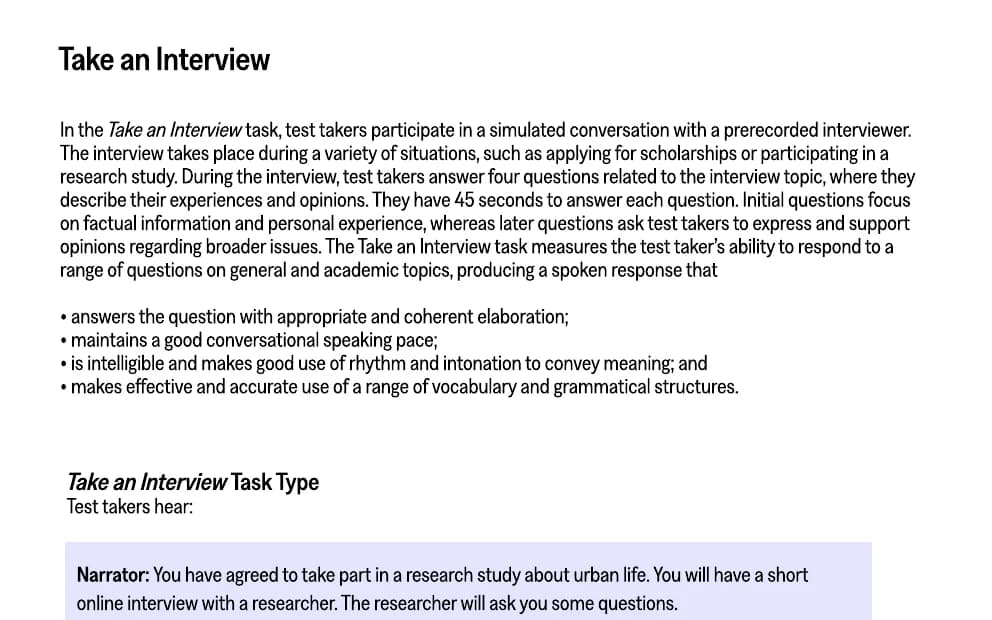
ETS describes a simulated interview connected to academic or campus life. You answer questions about experiences and opinions. No specialized background knowledge is required, so the challenge is not remembering facts; it is forming a clear answer in real time.
A useful response should make its direction easy to hear. Give the direct answer, develop one reason or example, and close the idea. More words do not automatically create a better answer. Relevance, clarity, pace, vocabulary, and grammar matter more than forcing a long speech.
Use the Take an Interview answer frameworks to practice opinions, experiences, choices, and follow-up questions without memorizing a script.
What changed in TOEFL scoring in 2026?
For tests taken on or after January 21, 2026, ETS reports each section and the overall result on a 1–6 scale in half-point increments. During a two-year transition period, ETS also provides a comparable overall score on the familiar 0–120 scale. Always check the current official score guidance and the requirement published by your target institution.
A practical weekly study split
| Day | Focus | Evidence to save |
|---|---|---|
| Monday | Listen and Repeat: short sentences | Exact-word accuracy and one pronunciation note. |
| Tuesday | Take an Interview: opinions | Direct answer, one reason, one example. |
| Wednesday | Listen and Repeat: longer chunks | Missed endings, substitutions, and pauses. |
| Thursday | Take an Interview: experiences | Situation, action, result, and relevance. |
| Friday | Mixed set | First attempt versus immediate retry. |
| Weekend | Review weak patterns | Three repeat errors and one delivery target. |
Use a correction loop, not endless new questions
The most useful speaking practice produces a visible difference between attempts. Record once, identify one accuracy issue and one delivery issue, then repeat immediately. If you only collect prompts, you become familiar with topics without correcting the habit that lowers clarity.
A simple loop: prompt → first response → transcript or careful replay → one targeted correction → second response → brief note. Keep the second attempt natural; do not turn it into a memorized performance.
Where Clario fits in your TOEFL preparation
Official ETS materials should be your source of truth for test rules, timing, and official scoring. For the daily speaking repetitions between official practice tests, Clario's 2026 TOEFL Speaking practice lets you work on both current task patterns, review focused feedback, and retry while the correction is fresh.
Clario provides independent practice feedback, not an official TOEFL score. TOEFL is a trademark of ETS; Clario is not affiliated with or endorsed by ETS.
Frequently asked questions
What are the TOEFL Speaking tasks in 2026?
For tests using the format introduced on January 21, 2026, the two speaking task types are Listen and Repeat and Take an Interview.
How long is the TOEFL Speaking section in 2026?
ETS lists 11 speaking items and an approximate base time of 8 minutes. Directions are not included in the base time, and the number of items and timing can vary as the test adapts.
Did the TOEFL score scale change in 2026?
Yes. Tests from January 21, 2026 use section and overall scores from 1 to 6 in half-band increments. ETS also reports a comparable 0–120 overall score during a two-year transition period.
Is Clario affiliated with ETS?
No. Clario is an independent speaking-practice app and is not affiliated with or endorsed by ETS. Practice feedback is not an official TOEFL score.